Home » Posts tagged 'broadway to film'
Tag Archives: broadway to film
Two Wonderful Little Films You’ve Probably Never Seen
So far this year, I’ve already watched 57 films — both at home and in theaters; commercial and independent releases. I’m not a movie blogger but occasionally I run across a film that I feel like I have to share. Here are two that you’ve probably missed.
Six Dance Lessons in Six Weeks (2014)
Director: Arthur Allan Seidelman
Screenplay: Richard Alfieri
Actors: Gena Rowlands and Cheyenne Jackson with cameos by Julian Sands and Rita Moreno
Running Time: 1 hour, 47 minutes
Teaser: A retired woman hires a dance instructor to give her private dance lessons at her home — one per week for six weeks. What begins as an antagonistic relationship turns into a close friendship as they dance together. (More)

Based on the short-lived, two person Broadway play, Six Dance Lessons in Six Weeks is a charming little film full of schmaltz. It received only a very limited theatrical release.
I found it to be laugh-out-loud funny and heart-warming.
The on-screen chemistry between Rowlands and Jackson is some of the best I’ve seen in years. I was completely engaged from beginning to end.
In spite of the title, this is not a dance film. It is a film about unlikely connections and how they can enrich our lives.
My rating: 9 Stars (out of 10)
Eden’s Curve (2003)
Director: Anna Misawa
Screenplay: Jerry Meadors, Hart Monroe
Actors: Trevor Lissauer, Julio Perillán
Running Time: 1 hour, 31 minutes
Teaser: A coming of age romantic drama set in 1972 based on real life events. This is Peter’s story; an 18 year old boy who takes a journey through a conservative southern all-male university in order to discover himself. With the help of his roommate, Joe and his roommate’s girlfriend, Bess, Peter begins to explore more about himself and his values only to be crushed by those who love him. The path becomes blurred and treacherous and Peter learns that only by relying on the strength of strangers will he be able to heal himself. The decisions he makes when confronted with this new truth will affect him forever. (More)

The Merchant Ivory film, Maurice (1987) came to mind while watching Eden’s Curve. I believe that’s because of the haunting mood and dreamy-like quality of the storytelling.
This film didn’t pull me in immediately but once it did– I was hooked. Younger audiences may have a hard time relating to the difficulties of coming of age and coming out exemplified in this film. (Times have changed.) For me, there was a direct connection.
Sexual situations play a prominent role in this film, which might not be for everybody.
This small budget Indie film is beautifully done.
My Rating: 9 Stars (out of 10)
I know I haven’t gone into great detail here but hope to entice you enough to discover these films for yourself as I did.
Six Dance Lessons in Six Weeks and Eden’s Curve are available on DVD and currently available to stream for free with an Amazon Prime membership.
My Top Three Favorite Musicals: Stage to Screen
With the recent release of the film version of Into the Woods, I thought it might be fun to share my top three favorite film versions of musicals that originated on the stage.
A number of adapted musicals have enjoyed big box office success and some are quite good; both for their stand alone entertainment value and in their homage to their source material. My Fair Lady and Grease are two good examples.
For me, there are three that stand above the rest for a variety of reasons. In two of the three cases, I think the film adaptations are actually better than the original stage versions.
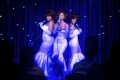
 Dreamgirls (2006) Directed by Bill Condon and adapted from the Tony Award-winning original 1981 Broadway musical directed and choreographed by Michael Bennett. Dreamgirls was nominated for 8 Academy Awards, winning two Oscars: Sound Mixing and Best Supporting Actress for Jennifer Hudson.
Suggested by the rise of The Supremes, Dreamgirls is an exuberant tribute to the sights and sounds of the 50’s & 60’s.

Dreamgirls (2006)
I find the film version superior to the stage production because of the visual, on location advantages and smoother scene/time transitions. The screenplay (by Condon) stays true to the original.
 Chicago (2002) Directed by Rob Marshall (Into the Woods). Screenplay by Bill Condon (Dreamgirls). Based on the 1975 Bob Fosse, Kander & Ebb musical, whose stripped-down 1996 revival, far exceeded the success of the original. Still running on Broadway after 18 years.
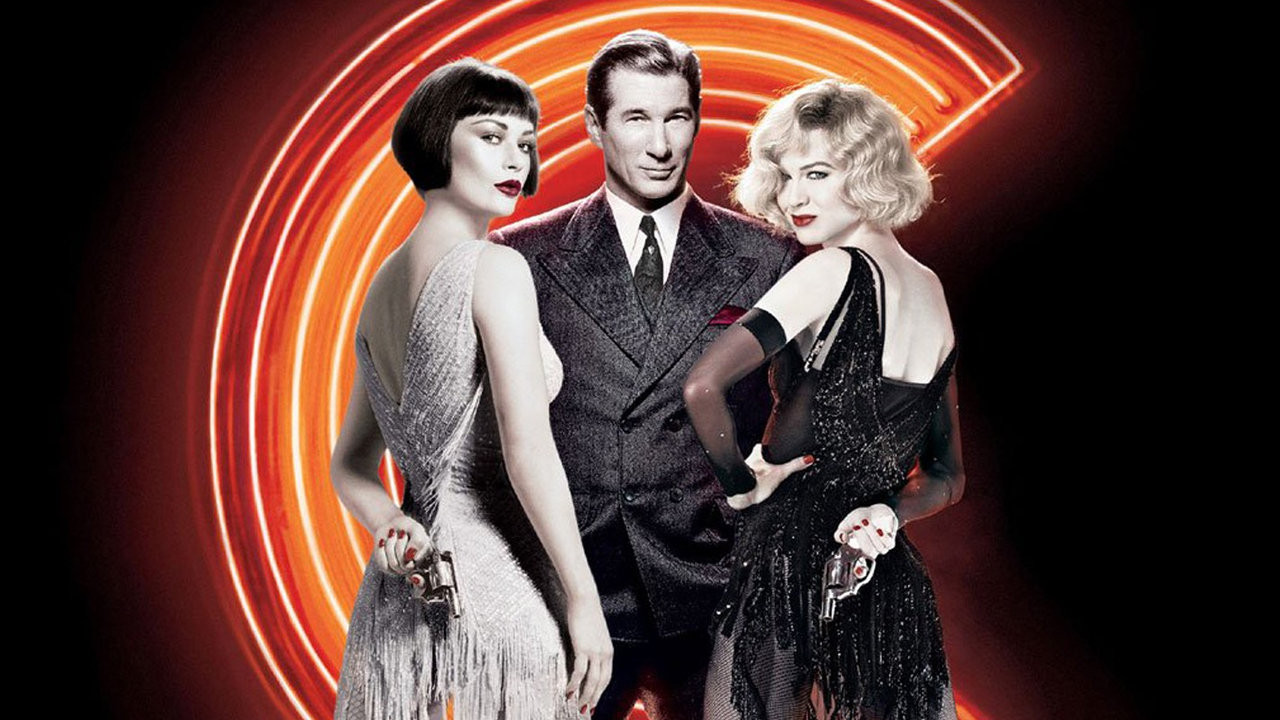
Chicago (2002)
I’m not a fan of the stage version. I find it drab and dull. On screen though, Chicago is an exciting, vibrant song and dance masterpiece. By far, the best example of a film adaptation being much better than the original.
 West Side Story (1961) Based on the classic 1957 stage musical, the film is a true representation of the original stage material and by far, my favorite movie musical of all time.
West Side Story is a contemporary re-telling of the Romeo and Juliet love story, told against the backdrop of the gang-controlled streets of New York.
Ground breaking in so many ways with some of the best choreography ever created, West Side Story is perfection.
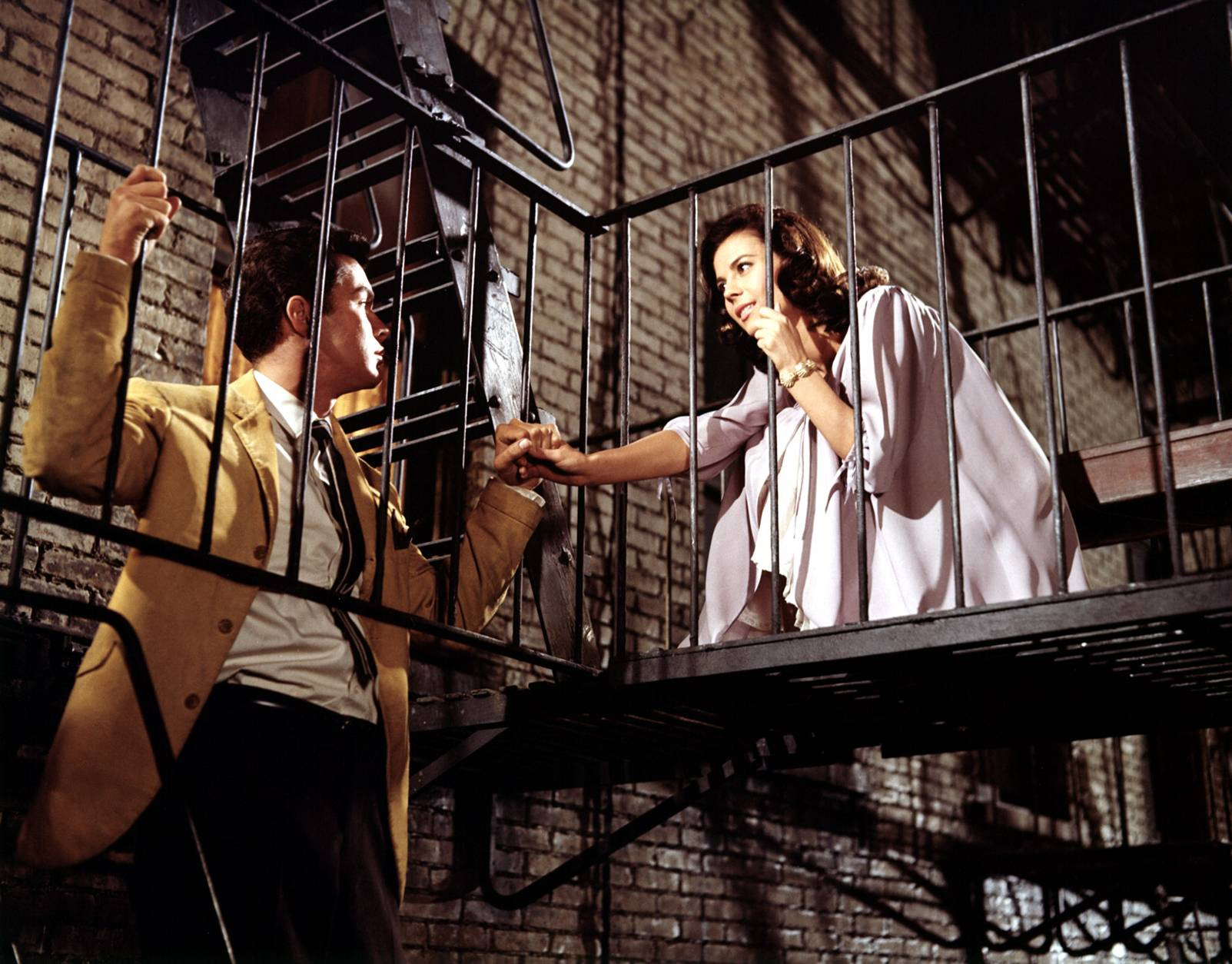
West Side Story (1961)
The result was honored with a record 10 Academy Awards– the most of any other movie musical and the fourth biggest winner, overall in Oscar history.
I’ve loved West Side Story since I was a kid. When I finally saw it live on stage for the first time, I was completely blown away. It’s one of the few works that I wouldn’t say one version is better than the other. The film and stage versions are equally brilliant.
I’m always shocked when someone says they’ve never seen West Side Story. If you’ve honestly never seen it. Put it on the top of your list now.
Why I Liked But Didn’t Love The INTO THE WOODS Movie

The good news is that Into the Woods was the second highest grossing film on Christmas Day and it finished third overall for the weekend.
The bad news is that I didn’t love it.
Let me compare Into the Woods to a piece of chocolate cake. Right off, you may either love or hate it because you might like or dislike chocolate, cake, or both. If you’ve never had chocolate cake before– this may be the most delicious thing you ever tasted. If you like chocolate cake– this may be satisfying; but if you love chocolate cake, this may be underwhelming or a complete disappointment. There are still others that will find– good or bad, dry or moist– they are just grateful to have a slice of cake.
For me, this version of ITW is missing key ingredients. Or to draw from the script– the potion is missing it’s hair as yellow as corn. It didn’t work for me.
The original Into the Woods clearly explores the price that comes with wishes, what is really happily ever after; and the importance of teaching children, wishes as children and the hope that exists in children themselves. Much of this is lost or brushed aside in the film. Instead of a film using fairy tales to tell a bigger story, it’s just a film telling fairy tales with a slightly different ending.
The movie is beautifully filmed and features an outstanding cast. BUT– I found it visually too dark; and with the major plot changes, I was never drawn in or emotional involved.
I have some pretty strong opinions about this particular film because I’ve had a long personal attachment to the stage version of Into the Woods.
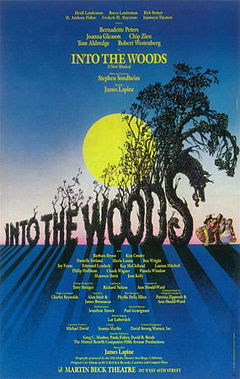
Poster for the original Broadway production of Into the Woods.
I saw the original 1987 Broadway production– twice, the 1988 first national tour, worked the theater where the second national tour began in Chicago (non-equity), saw the 2002 Broadway revival, designed the set and costumes for a local high school production; and have seen literally dozens of professional and amateur productions over the years.
The stage version of Into the Woods is visually a combination of light (colorful) and dark images, where the movie was visually dark from start to finish. The village and castle scenes in the movie all had a dingy, dirty feel as opposed to embodying color, light or any fairy tale magic. Emotionally, the movie is pretty much gray from start to finish. I didn’t feel the passion of the dreams and wishes from the major characters; which is problematic because it leaves no real reason for them to go into the woods to begin with. We never truly see even a glimpse of the happy ever after they are so desperate to achieve.
Even in the worst productions I’ve seen, no matter how badly acted or staged– I’ve always been moved by No One Is Alone. Except in the film. To borrow from another musical, I felt nothing.
Some might feel that it is to Disney and director Rob Marshall’s credit that they didn’t Disneyfy the look of the film. I see it as a missed opportunity to enhance the story. I really would have appreciated seeing some of the beauty and opulence of the castle, for example. Instead, it was dark and drab, as was the brief wedding imagery.
In adapting for the film, the writers chose to edit and whitewash the deeper, meaningful moments of the story. Combining that with the lack of passion, it left very little to get emotionally involved in.
Without Rapunzel’s demise, we lose the witch’s profound grief that propels her into a frenzied Last Midnight. Without a larger presence of the Baker’s Father (Mysterious Man, or not) and the cut song No More, we lose what is the cathartic moment that leads to the Baker’s return to his new family. As a result, the intensity and the pure, desperate passion is lost from characters’ motivations.
One of the early moments in the film set the tone for me. Jack’s Mother, played by the incredible Tracey Ullman, was directed to be purely a serviceable character on screen. (In the stage version, she is a warm, witty and lovable character.) I believe this was done to lessen the audiences’ attachment and thus, later in the film: the reaction to her death; which also seemed somewhat muddled. Jack didn’t seem terribly upset when he found out his mother was gone, nor did Little Red over her Granny. (And did it bother anyone else that Little Red suddenly looked like Dorothy in the Wizard of Oz for the remainder of the picture?)
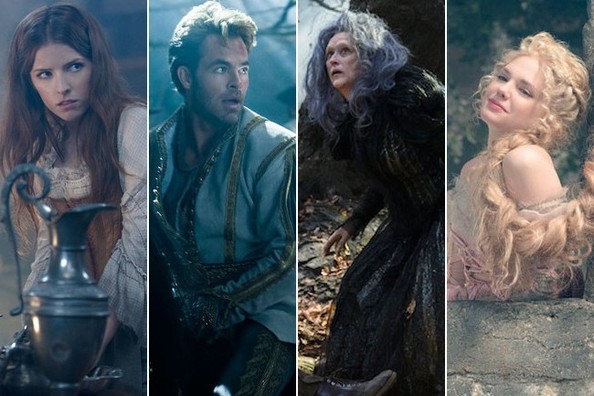
Cast of Disney’s film, Into the Woods.
The character of the Witch and Meryl Streep’s performance have to be looked at separately. First, I didn’t feel like the other characters really feared the Witch and her power as much as they saw her as a means to get what they wanted, or as an obstacle in doing so. Second, since the film chose to let Rapunzel ride off with the Prince, future unknown– instead of becoming a victim of the giant; it lessened the Witch’s loss. These two points affect the whole dynamic of the Witch’s antagonistic role in the story, as well as her motivations.
Meryl Streep, easily the greatest American actress of our time, fully embodied what the film set out to portray. Though I hoped for a much more powerful performance, Streep filled the bill the way the story has been adapted, perfectly. One thing I noticed, having listened to the soundtrack since; you don’t really grasp the incredible technique and emotion Streep brought to the character– vocally, in one viewing in a theater. Meryl Streep doesn’t just sing musical roles– her vocalization is a well-crafted extension of her character’s development and expression. Every word, phrase and guttural sound is perfection.
I liked the introduction of the blue moon to the story, opposed to just the passing midnights of the stage version. I thought it gave a clearer understanding of why the spell had to be broken now.
For me, the best and only perfect moment in the film was Agony. It was beautifully acted and staged. If the entire film had this energy and attention to detail, it could have been the best stage musical-to-film ever made.

Composer/Lyricist Stephen Sondheim.
I remember thinking about two-thirds of the way through: Where is all the music? A substantial amount was cut and occasionally reduced to underscoring. This is composer Stephen Sondheim’s baby. Though he and original book writer James Lapine were actively involved in the film, I feel they caved in to the studio pressures, too much, just to get this film made.
From all that I read leading up to the film’s release, Disney was concerned about the original version being too dark (plot-wise), too many main character deaths and wanted to make it more family-friendly. The result is a watered down story that still, in my opinion, is not a family movie.
Into the Woods, on screen, felt like it was too long. This is ironic since it was 20 minutes shorter than the stage version, not including an intermission. It was more than a little slow and disjointed at times.
I’m sure people completely unfamiliar with ITW will have a completely different reaction to the film. And that’s okay. I just hope it’s a positive experience. The very best thing that could come out of the film is that it might encourage a new audience for the stage version. The film versions of other more recent movie musicals have done a great service to building and keeping audience interest in live theatre.
I can only hope that this film will contribute to that trend.
 How Do You Measure 525600 Minutes?