Home » Posts tagged 'Kensington Palace'
Tag Archives: Kensington Palace

Travel 2017: Gardens, Rock and Robbery: Day Two

The Guard House at Kensington Palace Gardens.
After a good night’s sleep and no noticeable jet lag, we had a quiet breakfast, then headed out for the day.
Our morning target was Kensington Palace and gardens. We already knew tickets for the palace, which included a special new exhibition, had been sold out for months.
Getting off the Tube we came upon Kensington Palace Gardens, which has been called “the most exclusive address in London” and is also known as “Billionaires Row”. There’s a guard house where you enter the street (and no photography allowed) which is lined with palatial mansions– many are the homes of foreign diplomats, or serve as foreign embassies. Prior to being renamed around 1870, the street was known as The Queen’s Road. It was the MI19 center, The London Cage, during World War II and the Cold War.
The beautiful tree-lined street was nearly silent under it’s shaded canopy.
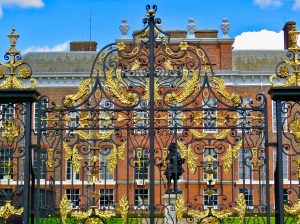
Looking through the ornate gates at Kensington Palace.
This led us to the gardens of Kensington Palace. Not exactly sure where we were headed, we walked towards the palace, then around it, until we found the specific garden we were looking for.
I’d like to note that even if you aren’t touring it, you can still get surprisingly close to the palace, which also hosts a cafe that is open to the public. Last trip, we only saw Kensington from across the green of Hyde Park.
We passed the visitor’s entrance and came upon a maze-like path that wound us around to the Sunken Garden.
Our particular interest was that the garden has been transformed into the White Garden, in commemoration of the 20th anniversary of Princess Diana’s death. This was one of Diana’s favorite spots and it has been filled with many of her favorite flowers to mark the occasion.
The White Garden will be open to the public through the summer of 2017.
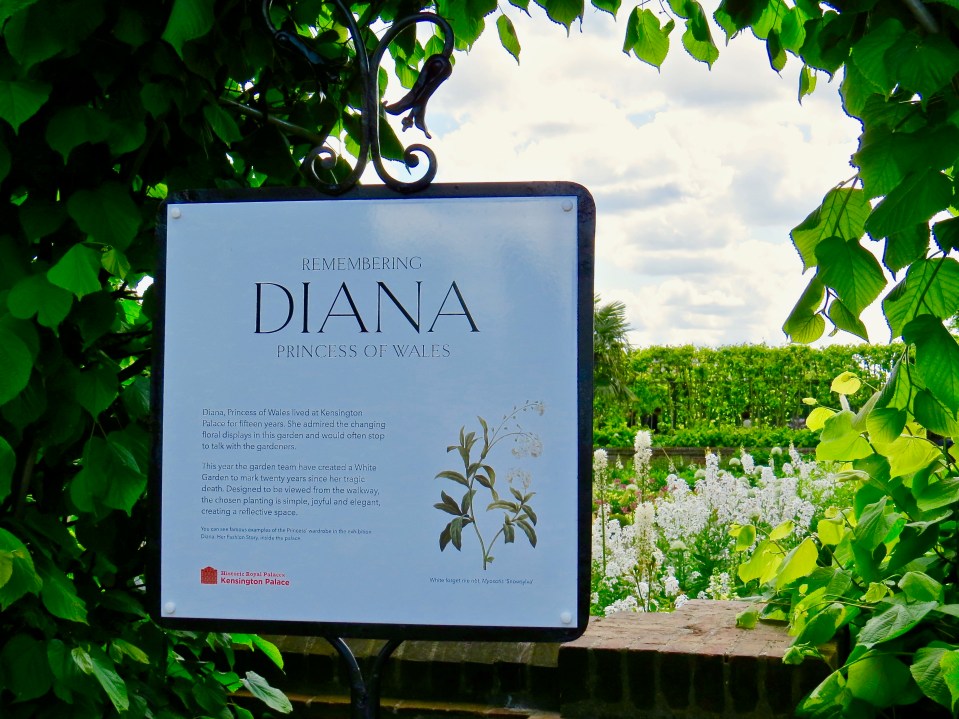
Remembering Princess Diana- The White Garden.

Beautiful arched trellises surround the Kensington Palace Sunken Garden, transformed into the White Garden to honor Princess Diana, 2017.

The Kensington Palace Sunken Garden has been transformed into the White Garden.

At the White Garden.
The Kensington Gardens, covering 242 acres are adjacent to Hyde Park, though crossing over from one to the other goes unnoticed.
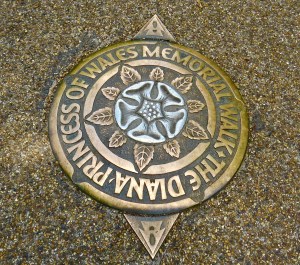
Princess Diana Memorial Walk.
We’d visited the other formal gardens on the last visit, so this time we set out in a new direction, down The Diana Princess of Wales Memorial Walk.
As quiet and peaceful as it was, everywhere you looked you’d see joggers, sunbathers, people enjoying family picnics and walking their dogs.
We reached the Long River and in addition to the beautiful swans, we had a great view of artist Henry Moore’s The Arch positioned on the north bank of the river.

Henry Moore’s ‘The Arch’.
We were soon following the Serpentine River, finding many people out boating and even swimming in a public recreation area.

Along the Serpentine River in Hyde Park.

Beautiful plantings throughout Hyde Park.
We had successfully walked the entire length of Hyde Park, reaching the Marble Arch. John Nash, designed the arch as the official state entrance to Buckingham Palace in 1827. The design was partially based on the Arc de Triomphe in Paris. After years of problems preventing it’s completion, it was finished quickly in time for Queen Victoria’s accession to the throne in 1937. But as Queen Victoria’s court and family quickly grew, it became necessary to build on to the palace, forcing the removal of the arch. It was moved to it’s current location at Cumberland Gate, the northeast corner of Hyde Park, completed in 1851.

The Marble Arch, originally the state entrance of Buckingham palace, moved in 1851.
If all we’d seen wasn’t enough, our day was just beginning, so to speak. It was just early afternoon and we still had two theatrical performances to attend.
School of Rock is a feel-good show for the entire family. A musical stage adaptation of the 2003 film, that starred Jack Black– it stays true to its source. (Michael and I actually just saw the movie again, shortly before our trip.) The show relies heavily on character stereotypes but that works well for this type of show.
This is an Andrew Lloyd Webber production and his theatrical roots have been based in shows with gimmicks. School of Rock’s gimmick is that all the younger performers actually play their own instruments on stage– something the production doesn’t let you forget.

School of Rock, London.
We both really enjoyed it. It’s lively, uplifting– and just plain fun, with a positive message. It also made me ask the question again: Why are young British performers uniformly better than their American counterparts?
We had one of those frequent London come-and-go rains while we were in the matinee. The streets were wet and glistening as the sun quickly returned to brighten the afternoon. We headed over to Piccadilly Circus and picked up the tickets for our evening performance.

Piccadilly Circus after a short rain.
We decided not to eat until after the evening show and spent the little bit of time we had– people-watching and enjoying the street performers scattered around Piccadilly Circus. Michael became particularly captivated by one performer that required audience participation for his act. It was a pretty simple and clever concept– he stood frozen until someone dropped a coin or two in his box and then he would come to life, taking his benefactor and posing them in a variety of positions. He would then add himself to the ‘picture’ with some amusing results.
Here’s Michael becoming part of the act:

Michael gets into the act with a Piccadilly Circus performer.
The Comedy About A Bank Robbery. It’s hard for me to put into words how impressed I am by the creativity and ingenious work done by the Mischief Theatre Company. We saw and loved their production, The Play That Goes Wrong, last September and were excited to see what else they could do.

The Comedy About A Bank Robbery, London 2017.
Going in, I honestly didn’t think I could have been more impressed than I had been with their last one. Minutes after the lights dimmed, I was proven wrong. By the time we reached the interval (intermission), I had absolutely no idea how they were going to get back to the base premise of the show. Hysterically funny, brilliant and thoroughly entertaining!
If you love British farce, slapstick comedy and really creative word play. See this show!

Entering the Tube at Piccadilly Circus.
We’d walked over 8 miles today, enjoyed some of the best parks and shows London has to offer. We couldn’t have asked for a better day!
Travel Date: May 14, 2017 Sunday (Day Two)

Travel 2016: Day Three – London Hop On Hop Off & a Blast From the Past
Big Ben & Me
We started the day with breakfast in the Chamber Club at our hotel, fueling up for our biggest sightseeing day in London.
London Hop On Hop Off Bus. (Golden Tours) With limited time to take in this amazing city, we looked forward to the HOHO bus as a quick way to see the major sights. (One Day Unlimited use was included with our London Pass.) There are four routes (with a lot of overlap) and we chose The Grand Tour.

Crossing the Tower Bridge on a HOHO bus.
I’d rename this The Grand Bore. Besides the fact that traffic was at a standstill most of the time; many of the major sights of London were hidden from view or around the corner from the bus route. When we did reach a landmark that we could see…. the bus often rushed by so fast it was hard to even snap a picture. A huge disappointment!
We’ve really enjoyed the HOHO buses in Chicago, NYC and Singapore. Unless you are using the bus as your transportation to get off at each stop in London, I wouldn’t recommend it. Even then, you are bound by the bus schedule which could have you waiting and losing more valuable time. Unlike the other cities I mentioned, there wasn’t the same satisfactory ‘city tour’ overview (riding the whole route as a tour) we experienced in the past. Plus, the tour narration (prerecorded, available in different languages) often didn’t sync up and restarted segments frequently.
There was one perk. That was crossing the Tower Bridge on an open top bus. I found that pretty thrilling.
We were only about halfway through the route when we decided we were wasting valuable time, so we got off at Hyde Park and took to the street.

A distant view of Trafalgar Square.
The Oyster Card. Before I launch into all the ground we covered today, I wanted to mention how easy the Oyster Card is to use. You scan/tap/swipe your card each time you start and stop travel whether it be the Tube (Underground), bus, train, etc. There are caps on the charges per day depending on the distance and zones you travel. So jumping on and off public transportation doesn’t have to be so expensive and is a fast, convenient way to get around the city.
We ordered our cards several months before our trip, already loaded with a balance so they were ready to go when we arrived. (Each person must have their own card.) You can reload them or cash them out at many stations but there is often a line. You need this card if you intend to use public transportation.
Hyde Park. One of the largest parks- 350 acres, Hyde Park is one of the Royal Parks. It’s often compared to Central Park in NYC, of course, they are quite different. One of the first spots we encountered was the Italian Gardens. A lovely, formal setting with fountains and statuary. We got a cup of coffee at the nearby pavilion and enjoyed this peaceful setting.
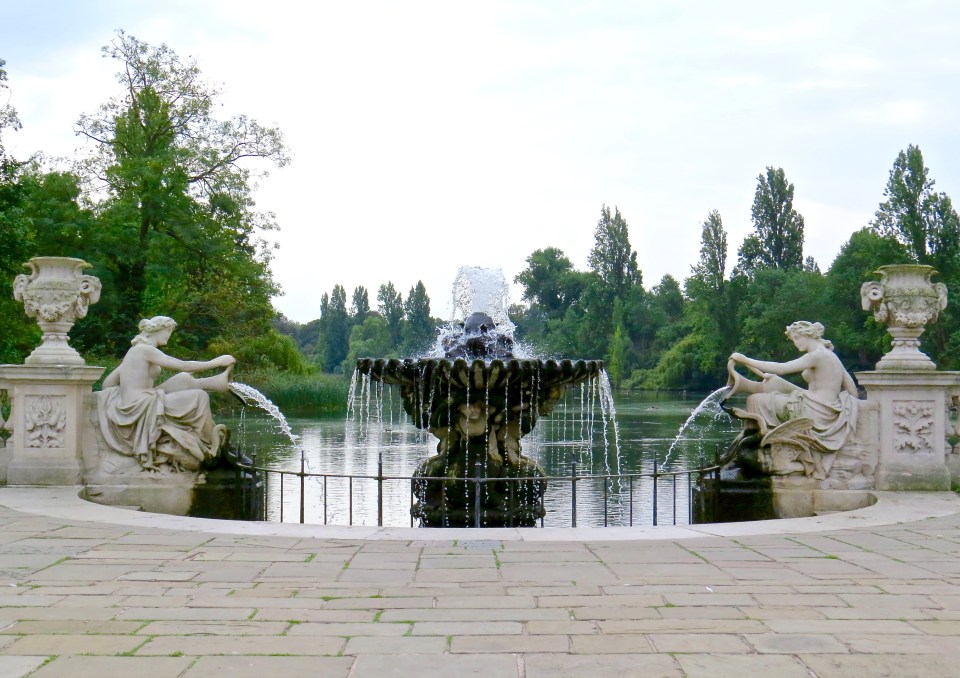
In the Italian Gardens of Hyde Park.

The Peter Pan Statue in Kensington Gardens.
Moving on through the park to Kensington Gardens we happened to find the bronze Peter Pan statue, paying tribute to J.M. Barrie’s immortal character. Barrie lived close to these gardens and drew upon them for inspiration.
Kensington Palace was next on our walk, currently the home of many Royals (include both Prince and William and Prince Harry) in different wings of the estate. Portions of the Palace are currently closed for renovation. With limited time, we had not planned to tour the interior of the Palace.

Kensington Palace from the gardens.
We continued our walk toward Royal Albert Hall and the massive Albert Memorial commemorating the death of Prince Albert at the early age of 42. The memorial was designed by George Gilbert Scott, who was also the architect of our hotel.

Strolling through Kensington Gardens towards Royal Albert Hall.

The Albert Memorial at Royal Albert Hall.
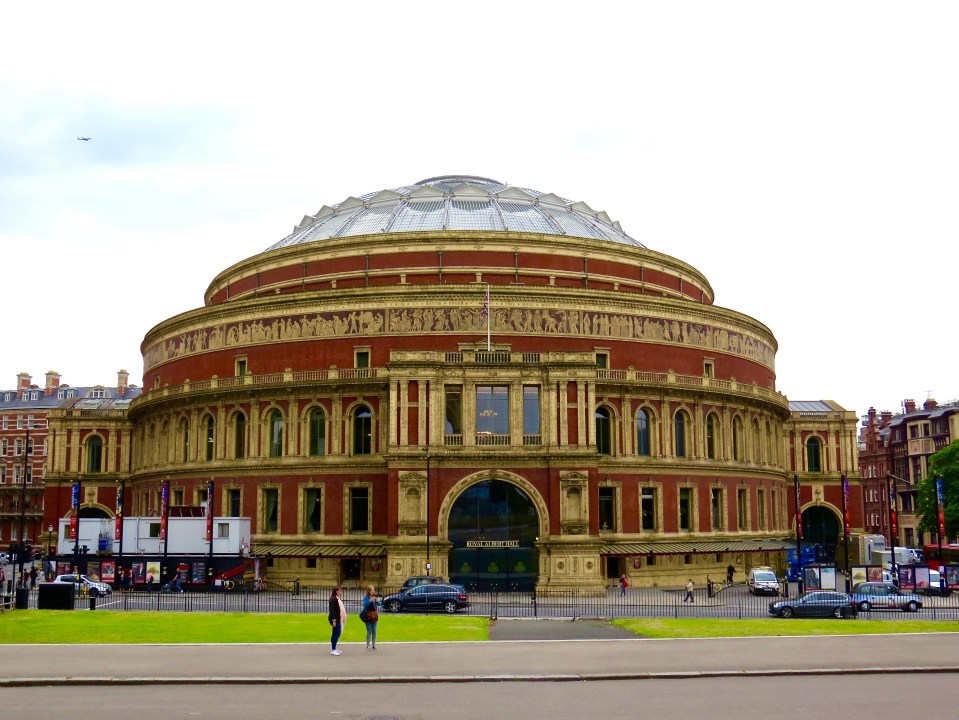
Royal Albert Hall.
The London neighborhood of Queen’s Gate.
Queen’s Gate. At this point, we left Kensington Gardens and headed to Michael’s old stomping ground in the Queen’s Gate neighborhood. Michael lived in London for six months while completing a college internship with the BBC in 1986… 30 years ago.
Michael found his old apartment building in this quiet, classic neighborhood and enjoyed reminiscing over fond memories. Including something about a fire and breaking a window. (Oops!)

Michael on the porch of his old apartment building in Queen’s Gate.
Michael’s apartment was just around the corner from the British Natural History Museum, designed by Alfred Waterhouse in the Victorian Gothic Revival style of architecture. We didn’t have a lot of time but we did run in and check out the massive lobby and first floor exhibits. NOTE: Most of the major museums in London are free to the public (with a suggested donation encouraged.)

The grand entry of the Natural History Museum.
Trying to see as much as possible in a city with so much to offer is a daunting task. We knew we wouldn’t have a lot of time to spend in London’s many wonderful museums. I researched many of them ahead of time and chose a couple I hoped to visit.

The Victoria and Albert Museum featuring art and design.
The Victoria and Albert Museum. I’m glad we selected V & A, featuring a tremendous collection based on art and design. The museum provides excellent temporary exhibitions in addition to the permanent collection. One of the reasons we chose this over other museums was the smaller size (comparatively speaking) and the ambiance– based on the way the collections were displayed. When done well, the space itself becomes art, with each installation becoming part of of the whole.
Entering the museum, you are welcomed in the rotunda by a stunning, modern chandelier by Dale Chihuly. It was first installed in 1999 but expanded and enlarged by the artist in 2001 to its current size.

The Dale Chihuly chandelier in the rotunda.

Beautifully displayed art in in the Victoria and Albert Museum.
After walking through much of the museum, we had Cream Tea ( tea and scones, complimentary with the London Pass) at the cafe across the courtyard from the main museum building. We could have easily spent several more hours here but we needed to move on. I’m sure we’ll return in the future.
Harrods.
Harrods. Since we were in the neighborhood, we made a brief stop at the world-famous department store, Harrods. Just walking through the jewelry and perfume sections was mind-boggling. Michael purchased his hard-to-find cologne and then we moved through the gourmet food section– quickly— exiting before our stomachs could start rumbling. (I’m glad we just had that scone!)

The clock of Elizabeth Tower that houses Big Ben.
Palace of Westminster. We took the Tube to Westminster for a closer look at the Houses of Parliament and Elizabeth Tower, most commonly referred to as Big Ben.
Big Ben is actually the nickname of the bell in the tower. The official name of the tower was Clock Tower until it was renamed in 2012 in honor of the Queen’s Diamond Jubilee.
Westminster Abbey is just west of the Palace and is most notable as the place of coronations and the burial site of British monarchs.
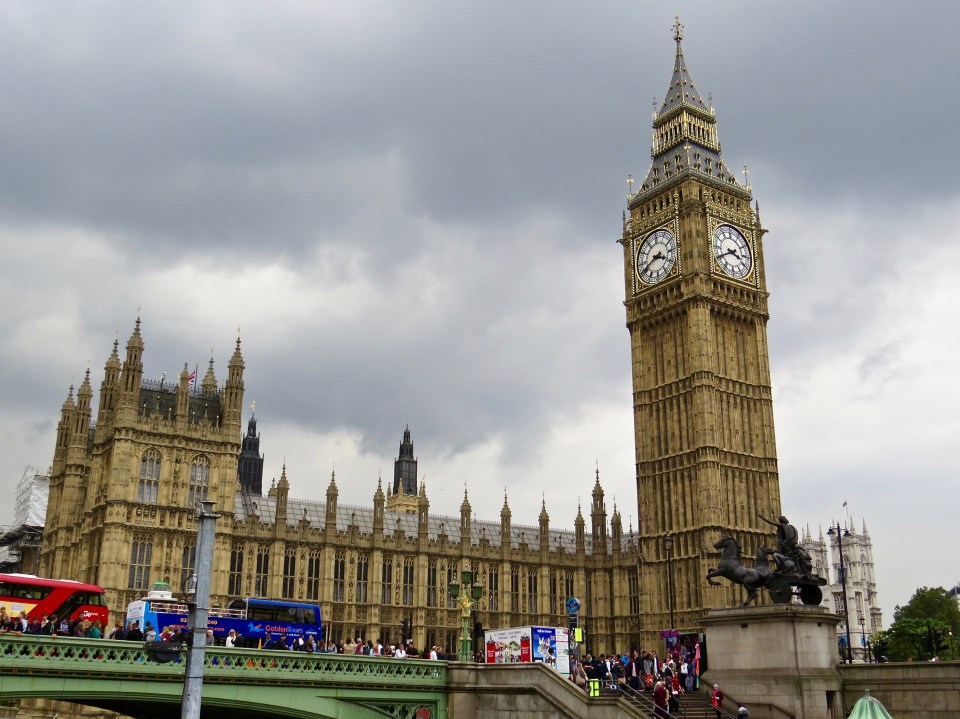
The Palace of Westminster.

Westminster Abbey.
Thames River Cruise. (Included on the London Pass.) We boarded the boat at Westminster for what was to be a short ride– but not short on visual delight. From the Thames you get great views of London and many of its iconic buildings and attractions.

Cleopatra’s Needle.
Some of the most notable were: the Palace of Westminster, the London Eye, St. Paul’s Cathedral, London Bridge, the Shard, Shakespeare’s Globe Theatre, The Tower of London, Tower Bridge and Cleopatra’s Needle.
Cleopatra’s Needle is actually a twin to one that now resides in New York City. It was originally from the Egyptian city, Heliopolis, erected there in 1450 BC. It was moved to London in 1877.
The forecast had predicted rain and the sky looked pretty threatening. The good news was that the rain held off and the boat wasn’t too full. This allowed me to be able to take some decent photographs.

The London Eye from the Thames River.

Shakespeare’s Globe Theatre.

The Shard, also known as Shard London Bridge.

St. Paul’s Cathedral is prominent in the London skyline along the Thames River.
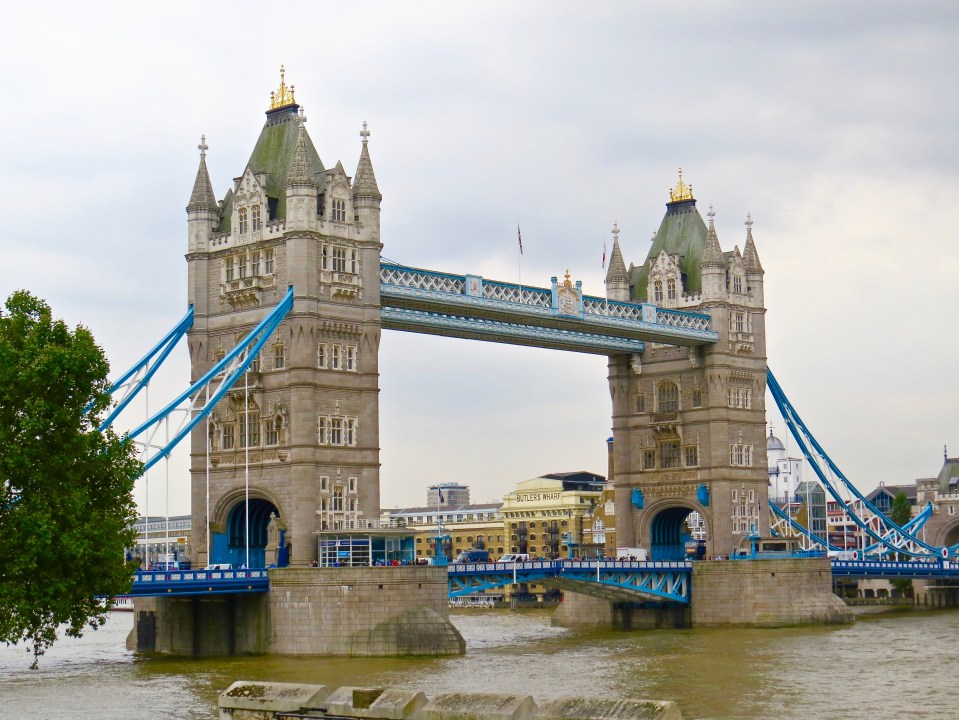
The Tower Bridge.

The Tower of London.
The cruise ended at a dock where the path split to either the Tower of London or the Tower Bridge. Here, we had to make a choice. We only had time for one before they closed. As much as I really wanted to walk the glass walkway across the Tower Bridge– we chose the Tower of London.
Tower of London. (Free with the London Pass.) This massive castle and fortress was built by William the Conqueror beginning in 1066 and is an UNESCO World Heritage Centre. I most enjoyed walking the walls of the fortress looking over the property and out at the city around it. While we were there, it started pouring rain so we tried to avoid it as much as possible, which also meant skipping the line to see the Crown Jewels.
At one point we made the decision to climb over 300 stairs which in the end, seemingly led to no where. The only stairs down left us trapped in a crowded basement gift shop. We had to maneuver our way through, only to climb more stairs to get out.
I’m glad I visited the Tower of London but found many of the displays, artifacts and replicas a little too “Disney” and not my cup of tea.

Two of the six “Guardians of the Tower”.
My favorite moment was finding two of the six ravens- the Guardians of the Tower— together. Legend says “If the ravens leave the tower, the Kingdom will fall…” There are actually seven ravens– the required six and one in case one goes missing. This legend and practice goes back to Charles II.

White Tower.
In our attempt to find the nearest Tube station we found Dickens Inn and decided to have dinner before our evening show. There were actually three different restaurant levels and we picked the one that doesn’t get busy until later in the evening– which might have been a good thing; but being early, service ended up being a little slow. Still, we were seated outside on a balcony with a cool breeze and a great view and that made up for the delay.
After dinner, even using the phone app, we got a little turned around in our directions. We got stuck in a maze of wooden walkways in this upscale little condo/boating enclave. Eventually we found our way out, made it to the Tube and back to Covent Garden for our fourth show in London.
The Curious Incident of the Dog in the Night Time.
The Curious Incident of the Dog in the Night Time. I was pretty stoked to see this play. It had won a lot of praise and awards on both sides of the pond. Michael and I really enjoyed the first act but thought it lost it’s momentum in the second.
Maybe it was just an off night or a problem with the pacing, in either case, we were left a little disappointed.

Piccadilly Circus.
Piccadilly Circus. What Times Square is to NYC, Piccadilly Circus is to London. It’s the center of activity in the West End. We walked through it after the show and took a few minutes to enjoy the vibe and to people watch. I see the comparison but think Piccadilly Circus is quite different and unique unto itself.
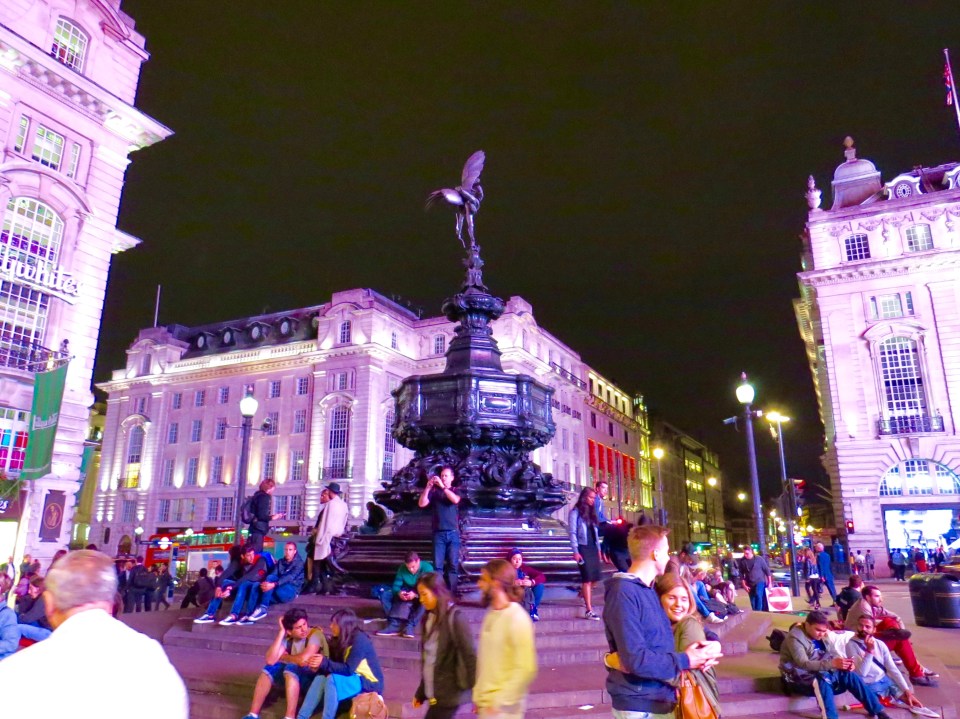
Piccadilly Circus.
What a day! Looking back it’s hard to believe we saw so much in a single day. Only one day left in London. Tomorrow? Buckingham Palace and more.
 How Do You Measure 525600 Minutes?