NetChallenge

Travel 2016: Day Three – London Hop On Hop Off & a Blast From the Past
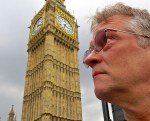
Big Ben & Me
We started the day with breakfast in the Chamber Club at our hotel, fueling up for our biggest sightseeing day in London.
London Hop On Hop Off Bus. (Golden Tours) With limited time to take in this amazing city, we looked forward to the HOHO bus as a quick way to see the major sights. (One Day Unlimited use was included with our London Pass.) There are four routes (with a lot of overlap) and we chose The Grand Tour.

Crossing the Tower Bridge on a HOHO bus.
I’d rename this The Grand Bore. Besides the fact that traffic was at a standstill most of the time; many of the major sights of London were hidden from view or around the corner from the bus route. When we did reach a landmark that we could see…. the bus often rushed by so fast it was hard to even snap a picture. A huge disappointment!
We’ve really enjoyed the HOHO buses in Chicago, NYC and Singapore. Unless you are using the bus as your transportation to get off at each stop in London, I wouldn’t recommend it. Even then, you are bound by the bus schedule which could have you waiting and losing more valuable time. Unlike the other cities I mentioned, there wasn’t the same satisfactory ‘city tour’ overview (riding the whole route as a tour) we experienced in the past. Plus, the tour narration (prerecorded, available in different languages) often didn’t sync up and restarted segments frequently.
There was one perk. That was crossing the Tower Bridge on an open top bus. I found that pretty thrilling.
We were only about halfway through the route when we decided we were wasting valuable time, so we got off at Hyde Park and took to the street.

A distant view of Trafalgar Square.
The Oyster Card. Before I launch into all the ground we covered today, I wanted to mention how easy the Oyster Card is to use. You scan/tap/swipe your card each time you start and stop travel whether it be the Tube (Underground), bus, train, etc. There are caps on the charges per day depending on the distance and zones you travel. So jumping on and off public transportation doesn’t have to be so expensive and is a fast, convenient way to get around the city.
We ordered our cards several months before our trip, already loaded with a balance so they were ready to go when we arrived. (Each person must have their own card.) You can reload them or cash them out at many stations but there is often a line. You need this card if you intend to use public transportation.
Hyde Park. One of the largest parks- 350 acres, Hyde Park is one of the Royal Parks. It’s often compared to Central Park in NYC, of course, they are quite different. One of the first spots we encountered was the Italian Gardens. A lovely, formal setting with fountains and statuary. We got a cup of coffee at the nearby pavilion and enjoyed this peaceful setting.

In the Italian Gardens of Hyde Park.

The Peter Pan Statue in Kensington Gardens.
Moving on through the park to Kensington Gardens we happened to find the bronze Peter Pan statue, paying tribute to J.M. Barrie’s immortal character. Barrie lived close to these gardens and drew upon them for inspiration.
Kensington Palace was next on our walk, currently the home of many Royals (include both Prince and William and Prince Harry) in different wings of the estate. Portions of the Palace are currently closed for renovation. With limited time, we had not planned to tour the interior of the Palace.

Kensington Palace from the gardens.
We continued our walk toward Royal Albert Hall and the massive Albert Memorial commemorating the death of Prince Albert at the early age of 42. The memorial was designed by George Gilbert Scott, who was also the architect of our hotel.

Strolling through Kensington Gardens towards Royal Albert Hall.

The Albert Memorial at Royal Albert Hall.

Royal Albert Hall.
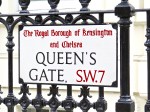
The London neighborhood of Queen’s Gate.
Queen’s Gate. At this point, we left Kensington Gardens and headed to Michael’s old stomping ground in the Queen’s Gate neighborhood. Michael lived in London for six months while completing a college internship with the BBC in 1986… 30 years ago.
Michael found his old apartment building in this quiet, classic neighborhood and enjoyed reminiscing over fond memories. Including something about a fire and breaking a window. (Oops!)

Michael on the porch of his old apartment building in Queen’s Gate.
Michael’s apartment was just around the corner from the British Natural History Museum, designed by Alfred Waterhouse in the Victorian Gothic Revival style of architecture. We didn’t have a lot of time but we did run in and check out the massive lobby and first floor exhibits. NOTE: Most of the major museums in London are free to the public (with a suggested donation encouraged.)

The grand entry of the Natural History Museum.
Trying to see as much as possible in a city with so much to offer is a daunting task. We knew we wouldn’t have a lot of time to spend in London’s many wonderful museums. I researched many of them ahead of time and chose a couple I hoped to visit.

The Victoria and Albert Museum featuring art and design.
The Victoria and Albert Museum. I’m glad we selected V & A, featuring a tremendous collection based on art and design. The museum provides excellent temporary exhibitions in addition to the permanent collection. One of the reasons we chose this over other museums was the smaller size (comparatively speaking) and the ambiance– based on the way the collections were displayed. When done well, the space itself becomes art, with each installation becoming part of of the whole.
Entering the museum, you are welcomed in the rotunda by a stunning, modern chandelier by Dale Chihuly. It was first installed in 1999 but expanded and enlarged by the artist in 2001 to its current size.

The Dale Chihuly chandelier in the rotunda.
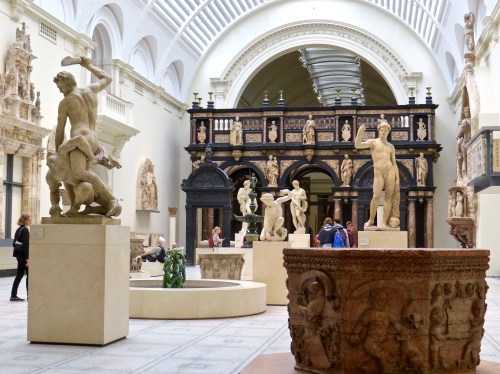
Beautifully displayed art in in the Victoria and Albert Museum.
After walking through much of the museum, we had Cream Tea ( tea and scones, complimentary with the London Pass) at the cafe across the courtyard from the main museum building. We could have easily spent several more hours here but we needed to move on. I’m sure we’ll return in the future.
Harrods.
Harrods. Since we were in the neighborhood, we made a brief stop at the world-famous department store, Harrods. Just walking through the jewelry and perfume sections was mind-boggling. Michael purchased his hard-to-find cologne and then we moved through the gourmet food section– quickly— exiting before our stomachs could start rumbling. (I’m glad we just had that scone!)

The clock of Elizabeth Tower that houses Big Ben.
Palace of Westminster. We took the Tube to Westminster for a closer look at the Houses of Parliament and Elizabeth Tower, most commonly referred to as Big Ben.
Big Ben is actually the nickname of the bell in the tower. The official name of the tower was Clock Tower until it was renamed in 2012 in honor of the Queen’s Diamond Jubilee.
Westminster Abbey is just west of the Palace and is most notable as the place of coronations and the burial site of British monarchs.

The Palace of Westminster.

Westminster Abbey.
Thames River Cruise. (Included on the London Pass.) We boarded the boat at Westminster for what was to be a short ride– but not short on visual delight. From the Thames you get great views of London and many of its iconic buildings and attractions.

Cleopatra’s Needle.
Some of the most notable were: the Palace of Westminster, the London Eye, St. Paul’s Cathedral, London Bridge, the Shard, Shakespeare’s Globe Theatre, The Tower of London, Tower Bridge and Cleopatra’s Needle.
Cleopatra’s Needle is actually a twin to one that now resides in New York City. It was originally from the Egyptian city, Heliopolis, erected there in 1450 BC. It was moved to London in 1877.
The forecast had predicted rain and the sky looked pretty threatening. The good news was that the rain held off and the boat wasn’t too full. This allowed me to be able to take some decent photographs.
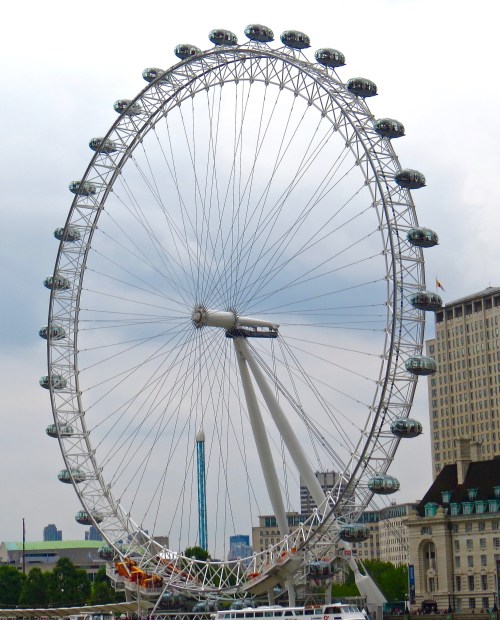
The London Eye from the Thames River.
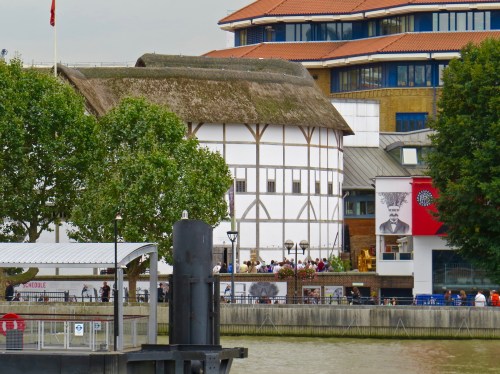
Shakespeare’s Globe Theatre.

The Shard, also known as Shard London Bridge.
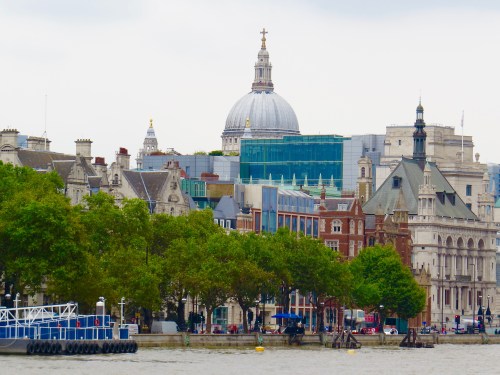
St. Paul’s Cathedral is prominent in the London skyline along the Thames River.
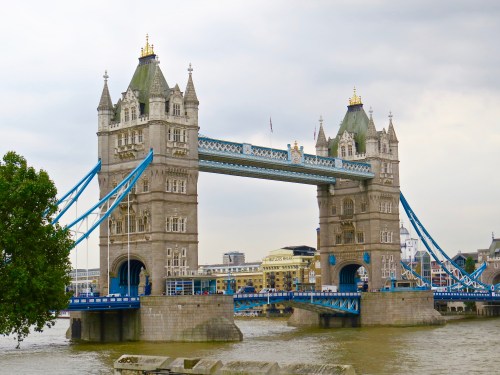
The Tower Bridge.

The Tower of London.
The cruise ended at a dock where the path split to either the Tower of London or the Tower Bridge. Here, we had to make a choice. We only had time for one before they closed. As much as I really wanted to walk the glass walkway across the Tower Bridge– we chose the Tower of London.
Tower of London. (Free with the London Pass.) This massive castle and fortress was built by William the Conqueror beginning in 1066 and is an UNESCO World Heritage Centre. I most enjoyed walking the walls of the fortress looking over the property and out at the city around it. While we were there, it started pouring rain so we tried to avoid it as much as possible, which also meant skipping the line to see the Crown Jewels.
At one point we made the decision to climb over 300 stairs which in the end, seemingly led to no where. The only stairs down left us trapped in a crowded basement gift shop. We had to maneuver our way through, only to climb more stairs to get out.
I’m glad I visited the Tower of London but found many of the displays, artifacts and replicas a little too “Disney” and not my cup of tea.

Two of the six “Guardians of the Tower”.
My favorite moment was finding two of the six ravens- the Guardians of the Tower— together. Legend says “If the ravens leave the tower, the Kingdom will fall…” There are actually seven ravens– the required six and one in case one goes missing. This legend and practice goes back to Charles II.

White Tower.
In our attempt to find the nearest Tube station we found Dickens Inn and decided to have dinner before our evening show. There were actually three different restaurant levels and we picked the one that doesn’t get busy until later in the evening– which might have been a good thing; but being early, service ended up being a little slow. Still, we were seated outside on a balcony with a cool breeze and a great view and that made up for the delay.
After dinner, even using the phone app, we got a little turned around in our directions. We got stuck in a maze of wooden walkways in this upscale little condo/boating enclave. Eventually we found our way out, made it to the Tube and back to Covent Garden for our fourth show in London.
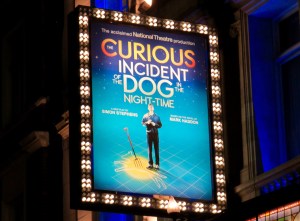
The Curious Incident of the Dog in the Night Time.
The Curious Incident of the Dog in the Night Time. I was pretty stoked to see this play. It had won a lot of praise and awards on both sides of the pond. Michael and I really enjoyed the first act but thought it lost it’s momentum in the second.
Maybe it was just an off night or a problem with the pacing, in either case, we were left a little disappointed.

Piccadilly Circus.
Piccadilly Circus. What Times Square is to NYC, Piccadilly Circus is to London. It’s the center of activity in the West End. We walked through it after the show and took a few minutes to enjoy the vibe and to people watch. I see the comparison but think Piccadilly Circus is quite different and unique unto itself.

Piccadilly Circus.
What a day! Looking back it’s hard to believe we saw so much in a single day. Only one day left in London. Tomorrow? Buckingham Palace and more.

Travel 2016: Day Two – King’s Cross to London’s Camden Market

Marylebone Grammar School.
After a good night’s sleep, we decided to head out on foot with only a tentative itinerary in mind. We had two shows booked and about six hours for exploring before then. We wanted to try and catch a boat ride at 10:30 am so we started walking that direction; up through King’s Cross and Marylebone to Little Venice.
Our friend George, highly recommended the phone app Maps.Me and so I’d downloaded the map of London as soon as we arrived. It’s a life-saver. What’s great is that once you have a map downloaded, you don’t need phone service to use it since it is GPS powered. We used it to get our bearings, locate points of interest and find the nearest Tube stops, never needing to worry when we’d wander off track.
We arrived in Little Venice early, giving us time to explore around the Regent’s Canal and grab breakfast at the Waterside Cafe. The restaurant itself, was a boat on the canal.

Jason’s Original Canal Boat Trip.
After breakfast, we boarded Jason’s Canal Boat Trip using our London Pass for a leisure ride around Regent’s Park (which covers 395 acres) to the Camden Locks. Jason’s has been operating since 1951 using a boat that’s over 100 years old.
The boat ride takes about 45 minutes. In addition to plenty of natural scenery, you glide past old and new estate homes, jogging paths and the London Zoo which flanks both sides of the canal.

Crossing under a bridge on the Regent’s Canal.
There are many bridges crossing the narrow canal allowing only enough width for one boat to pass through at a time.
At the end of the line, we reached the Camden Locks that are still manually operated to this day. The twin locks were originally constructed in 1818 and 1820. They now have Grade II historic designation and protections.

Welcome to Camden Market.
We got off the boat and found ourselves in a wonderland of food and unique treasures. The Camden Market started out open only on weekends but became so wildly popular it is now open daily.
Camden Market is an indoor and outdoor marketplace housed in multiple buildings and connecting streets. It’s a must-visit destination requiring anywhere from a couple hours to a full day of exploration.
Whether you are a treasure hunter, tourist or window shopper –there are multitudes of unexpected gems to taunt the senses. You can find food and trinkets here from all over the world.

Outdoor stalls at London’s Camden Market.
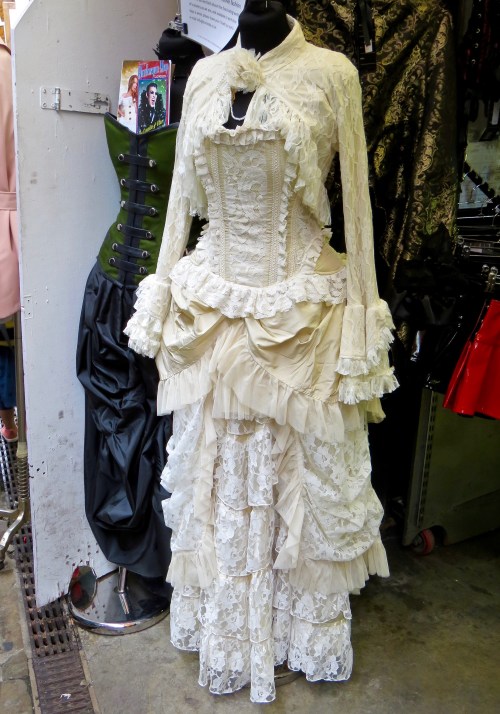
Several sellers exclusively merchandise to the Steampunk crowd.

Exotic textiles at Camden Market.
New and perfect-condition vintage clothing, steampunk accessories, old records, lamps, artwork, new and heirloom jewelry– it’s all here. If you can dream it- you’ll probably find it.
London has a truly first-class zoo. With a little time before our matinee, we used our London Pass for fast-track entry and a rather rushed but enjoyable visit.
Opening in 1828, the London Zoo is the world’s largest scientific zoo. Today, the zoo features 756 species of animals. It’s as much a park as it is a zoo. Large green spaces, well constructed exhibition grounds and something to appeal to all ages.
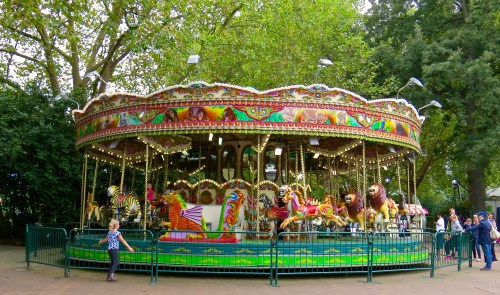
The carousel at the London Zoo.

Lions at the London Zoo.
Show Time
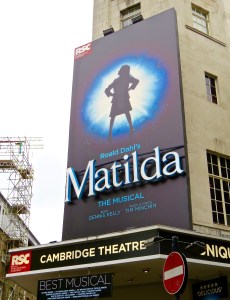
Matilda the Musical at Cambridge Theatre in Covent Garden.
We headed back to Covent Garden for the matinee performance of the musical, Matilda. Based on the popular children’s book, it made for a colorful and entertaining afternoon. I’m really glad we waited to see it here in London.
We had just enough time between shows to catch a nice dinner at Cote Bistro, in the theatre district.
Our evening performance was what might be considered standard British farce. The Play That Goes Wrong is funny, funny stuff. The plot centers on a community group putting on a play. As the title suggests, everything that can go wrong does so hysterically.

The Play That Goes Wrong at the Duchess Theatre.
For my theatre friends– every single thing that could possibly happen, or you have ever experienced going wrong in a show, is included. I couldn’t think of one possible thing they left out.
After the show, it was back to Shake Shack at Covent Garden Market for a chocolate-peanut butter concrete, then headed underground for our Tube ride back to St. Pancras.

Travel 2016: St. Pancras Renaissance Hotel London – A Photo Essay
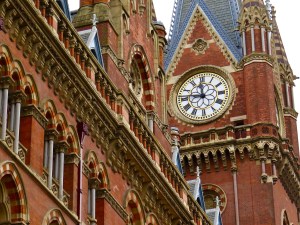
The restored clock at St. Pancras.
You’re probably familiar with the St. Pancras Hotel and didn’t even know it. Have you seen Harry Potter and the Chamber of Secrets? In an early scene of the movie they fly right by it. The Spice Girls video “Wannabe” was filmed at the entrance and on the grand staircase, prior to the hotel’s massive renovation.
The London neighborhood of King’s Cross was a major train hub, both freight and passenger trains, in the late 1800’s, with four major train stations located there. St. Pancras was opened in 1868 owned by the Midland Railway Company. The Midland Grand Hotel, a stunning work of Victorian Gothic architecture, designed by architect George Gilbert Scott, opened in the attached space in 1873.
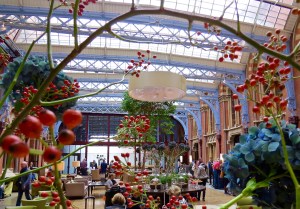
Inside the lobby of the restored St. Pancras hotel.
Unfortunately, the hotel closed in 1935 when it became too costly to run with its outdated utilities, and was used mainly as office space after that. In addition, train terminal was hit by bombs during WWII causing extensive damage.
This incredible landmark was almost demolished in the late 1960’s after falling into major disrepair. Luckily, with great effort and much expense, it was saved.
St. Pancras Renaissance Hotel London is actually part of the larger complex known as St. Pancras International. Eurostar began providing high speed train service to Paris in 2007 and the hotel reopened in 2011 with a five star rating.
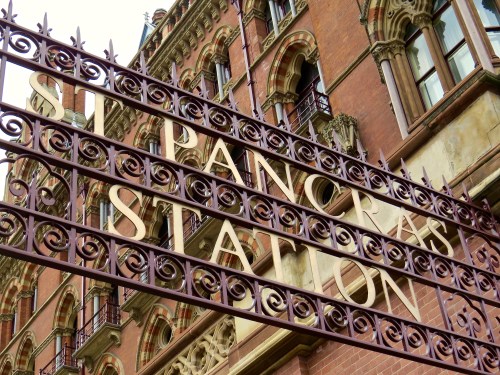
Exterior at St. Pancras International.

The original design of the train terminal at St. Pancras International was by William Henry Barlow.
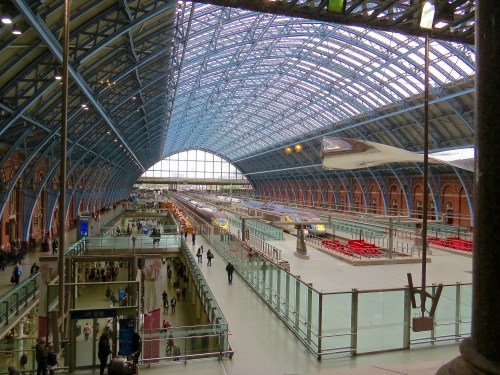
Eurostar High Speed Trains provide service to Paris.
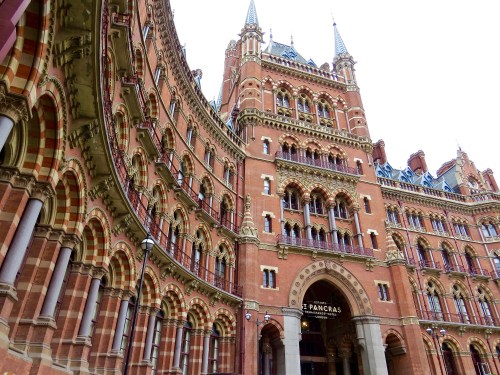
The Victorian Gothic entrance designed by George Gilbert Scott.

This magnificent building is too large to photograph.

The restored clock tower at St. Pancras International.
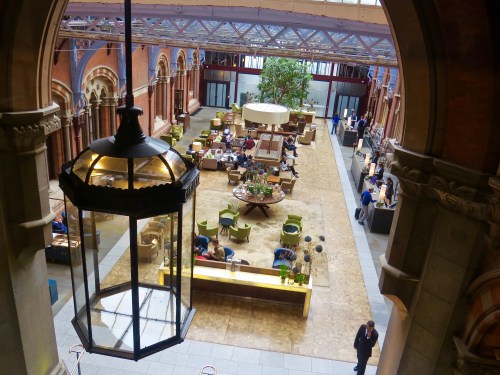
Looking down at the lobby of the St. Pancras Renaissance London Hotel.
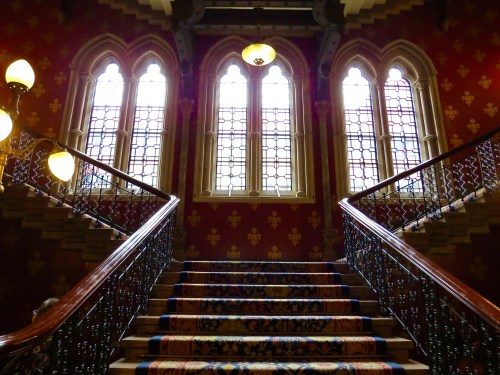
The grand staircase at St. Pancras Renaissance London Hotel.
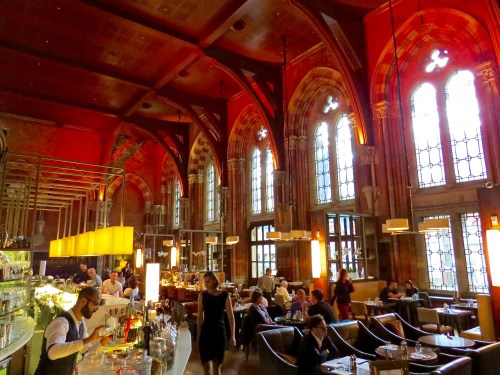
Inside the Booking Office Bar & Restaurant, once the ticketing office for train passage.

The ceiling inside the Gilbert Scott Bar.

The Gilbert Scott Restaurant.

The bedroom of the Sir George Gilbert Scott Suite.

The bathroom in the Sir George Gilbert Scott Suite.

A touch of whimsy.

The living area in the Sir George Gilbert Scott Suite.
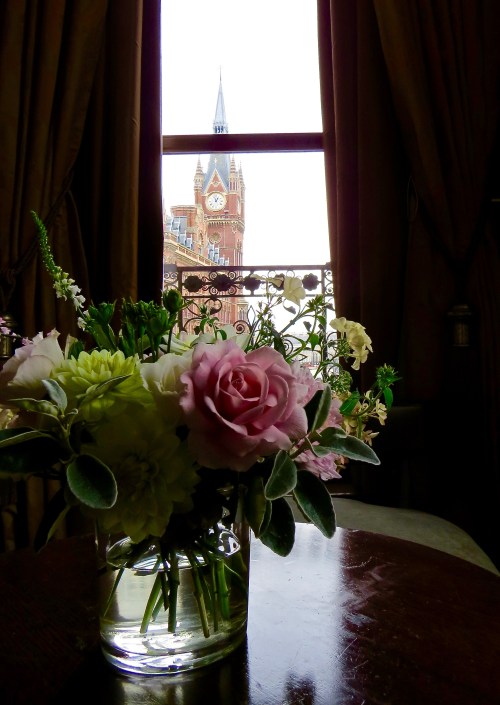
Fresh flowers and a view of the Clock Tower.

The Gothic Windows of Grand Staircase.

A view at the Grand Staircase.

Looking up along one side of the Grand Staircase.

Looking down the center of the Grand Staircase.

Looking down one side of the Grand Staircase.
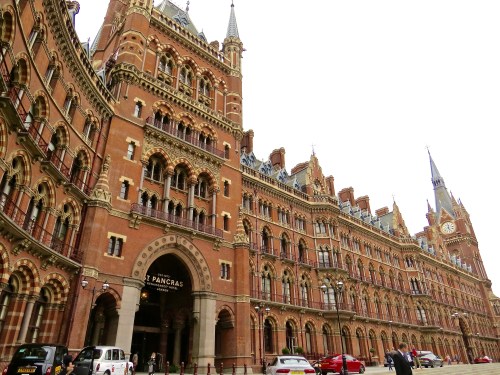
The exterior of St. Pancras Renaissance London Hotel & St. Pancras International.
Travel 2016: Day One – London (and getting there)
London, Rome and Broadway On the High Seas 7- cruising southern Italy. This time around, we booked our own pre cruise adventure– with the exception of the hotel in Rome, booked through Playbill Travel. The first five days we were on our own to create our own experience.
It’s funny how months of preparation and research fly out the door in the few days prior to leaving on an extended vacation. This was our third trip overseas and you’d think I’d be used to that last-minute feeling of anxiety but it still takes me by surprise. I suddenly found myself forgetting and rechecking everything I’d prepped for; probably asking Michael the same questions repeatedly, hopefully not driving him too insane. All the research on London and Rome was a jumbled mess in my head so I found myself going back over notes I’d made just to be sure I was ready.
The Flight
This was the first time traveling since we got the Global Entry clearance which includes TSA Pre-check. Of course, wouldn’t you know I was one of the people randomly selected to be scanned at security. Luck of the draw.
We flew to London Heathrow, direct flight, business class– on an evening flight out of Chicago O’Hare. The seating on this American Airlines flight was cozy yet smaller than past times we’ve flown business class. I watched two movies: All the Way and Trumbo, both starring Bryan Cranston, and enjoyed them both. Though I did manage to get a little sleep, I’ve found it’s really difficult for me to sleep more than a couple hours in the air. Michael, on the other hand, can sleep like a baby.
Overall, the flight was comfortable and it was on time. We arrived at Heathrow shortly after 9 am and breezed through to pick up our luggage.

The Tube is the best affordable way to get around London.
Luggage and the Tube
We don’t travel as light as we probably should, so we found ourselves both lugging our two checked bags and two carry ons– that’s right… on the Tube. Aside from being a little awkward manipulating, it wasn’t as bad as I thought it might be. Except– that moment when we reached the first very steep escalator in one of the stations. I had a moment of acrophobia and kept it under control by staring at the back of Michael’s head.
The ride took us about 45 minutes to reach central London. Did I mention that I still didn’t know where we were going?
You Call THIS a Hostel?
Michael spent many hours researching London accommodations, months prior to the trip. To keep me guessing, he decided that our destination would be a surprise. It became a running joke that we were staying in a seedy hostel, complete with rats, paper-thin mattresses and a shared bath.
As we got closer to the trip, Michael would get “daily email updates” that he’d share with me each morning before he left for work. He’d inform me of pending updates such as ‘new pots to catch the water from the leaky roof’, warnings to ‘sleep with one eye open’, our daily ‘work assignment’– crazy stuff like that.
I can’t tell you how many times we’d finish watching TV or a movie and he’d say, “Did you see our hostel?” It was even one of the locations used in an episode of Downton Abbey that we re-watched before the trip. I was clueless.
The whole time, I knew I was in for something pretty incredible but Michael still managed to outdo himself. Our ‘hostel’ turned out to be the historic and opulent, St. Pancras Hotel.
St. Pancras Renaissance London Hotel
We got off the Tube at King’s Cross, exited the station to the street and Michael just stopped in his tracks. “There’s your home for the next few days,” he said. I looked around and was a little confused. All I saw was this stunning, monster of a building– complete with clock tower, across the street. Overwhelmed would be an understatement. Welcome to St. Pancras!

My first view of the St. Pancras Renaissance London Hotel.
Arriving early in the day, we didn’t expect our room to be ready. I soon found out Michael had scheduled a tour of the impressive building shortly after we checked our bags. (I’ll write a separate blog post just on the hotel– too much to include here and visually too impressive not to share.)
After touring this magnificent facility, we were able to check in to our room. And as if my head wasn’t already full enough, Michael had snagged of of the three designer suites in the hotel– the Sir George Gilbert Scott Suite. The suite was named after the building’s architect. You’ll see in my next post, images of this carefully restored slice of history.
Staying in the historic section of the St. Pancras, we also had exclusive use of the Chambers Club where we could have breakfast, afternoon tea or just relax.
After settling in, we had just enough time to head out, catch the Tube and do a little exploring before our first show.
My First Visit to the West End
The West End is often referred to as London’s equivalent of the Times Square Theatre District in New York City– only it isn’t. Yes, it is the hub of many entertainment venues in London but that is where the comparison stops. I found the West End to be quite charming and warm. Though it was bustling with activity, it was still easy to take a relaxing stroll through the area. The streets are loaded with unique shops and quaint restaurants enticing theatregoers around every corner. There is completely different vibe here than the tourist-driven frenzy that exists in New York.
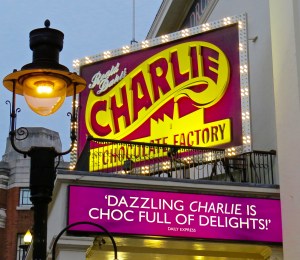
Charlie and the Chocolate Factory marquee at Theatre Royal Drury Lane.
Our first show– my first ever in London, was Charlie and the Chocolate Factory. Perhaps a little ironic that it was written by the American musical theatre team of Marc Shaiman and Scott Wittman who also wrote the hit musical, Hairspray.
I loved it! As opposed to trying to compare it to other productions, I’ll say this: It was probably my most thoroughly-satisfying theatregoing experience in the past ten years. The physical production, the cast and the adaptation were all nothing short of magical. As one of my most favorite and most-memorable books growing up, this production of Charlie… made me feel like a kid again– rediscovering Roald Dahl’s delicious tale as if it were the first time. I can’t say enough good things about it.
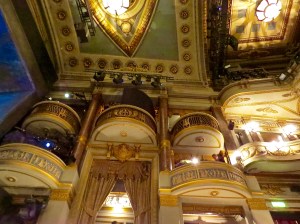
From our seats, inside the Theatre Royal Drury Lane.
By the way, Charlie and the Chocolate Factory is slated to make it’s Broadway debut next spring.
After the show, we took a leisure stroll through the West End with one destination in mind: Shake Shack.
The Shake Shack on 8th Ave has become one of our go-to places when we’re in NYC. With their popularity growing, others have started to sprout up in major cities around the world. (London already has three.) Michael and I both love their thick creamy concretes and their burgers and Chicago style hot dogs are good too. London’s Covent Garden location didn’t disappoint. It became our nightly stop before returning to the hotel every night after our shows.
Bellies full and exhausted, we returned to our hotel and actually slept through the whole night, peaceably.
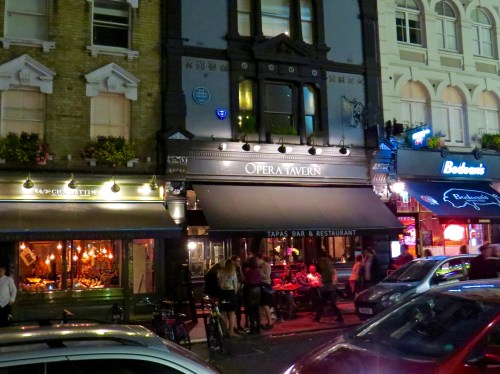
On the street in the West End.
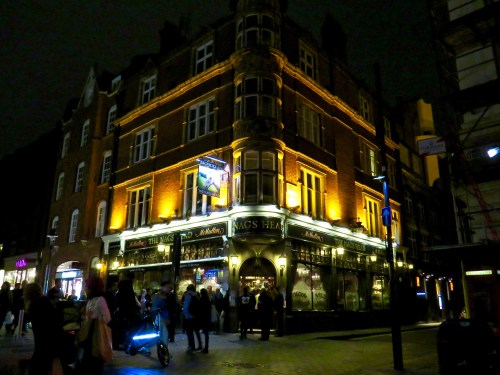
The Nags Head in the West End.
2016 Vacation Preview: London, Rome & Broadway On the High Seas 7
Eight Months. That’s how long we’ve been researching and anticipating this trip. Including travel, we’re on a 16 day journey exploring parts of Western Europe. Unlike past travels abroad, nearly half of this trip we planned on our own, without any pre-planned itinerary.
I’ll be updating blog posts throughout the trip, with lots of pictures along the way.
London
I’ve never been to London. Michael lived there for six months while completing an internship (with the BBC) in college. He didn’t do a lot of the touristy things while he was there, so it will still be like experiencing the culture and the history of London for the first time.
We have our Oyster Card, our London Pass and booked a tour of Buckingham Palace and the gardens. With only four short days to try and absorb it all– we’ve made lists and itineraries of what we most want to see. Doing the research ahead of time and knowing we can’t see everything, we plan to go and just have a great time, seeing what we can without the pressures or expectations of doing everything.
In addition to experiencing the city, we’ve booked tickets to see five shows. Charlie and the Chocolate Factory, Matilda, The Curious Incident of the Dog In the Night-Time, The Play That Goes Wrong and Funny Girl.
Rome
We have three days to run around Rome. We’re staying, as what is considered part of the ‘pre-cruise’, with all sightseeing on our own. We plan on doing a lot of walking– from the Spanish Steps to the Colosseum. We’re saving the Vatican until after the cruise.
Broadway On The High Seas 7 Cruise in Italy
We’re sailing on the Silversea ship, Silver Wind which only accommodates 294 passengers with a crew of 208.
The entertainers this time around are an eclectic, exciting mix of Broadway alumni.

Broadway Stars will shine on BOTHS7 in Italy.

We leave Civiavecchia with stops in Sorrento; Taormina; Valletta, Malta; Trapani; Cagliari; Bonifacio, France; and returning to Civiavecchia.
We’ll have daily land excursions (including a visit to the ruins of Pompeii) with wonderful concerts aboard ship at night. It’s like two vacations in one.
Following the cruise, we’ll be back for one more full day and night in Rome.
We’re looking forward to an incredible adventure.
Silence
Silence.
Voices hushed.
Lives stolen.
Dreams shattered.
Promises unkept.
Memories lost.
Just silence.
Out of the abyss there is a cry in the dark.
It starts softly, faintly
Piercing the silence.
It grows louder
Wailing
It seems to come closer
Until it becomes a deafening scream.
Then it passes
Fading to a whimper
Another visit of that nightmare gone
Then just silence.
This is my memory. This is my grief. This is my mourning.

Friday morning, I stood alone in a field of flags. Crying. Remembering. I was surrounded by 2,976 American flags blowing gently in the breeze.
3051 children lost a parent that day. Their average age was 9 years old.
I walked through rows and rows of flags in a field of rain soaked grass, I began reading the markers: citizens, police officers, firefighters…. and their ages…. 34, 41, 32… 21.
21. Lukasz Milewski.
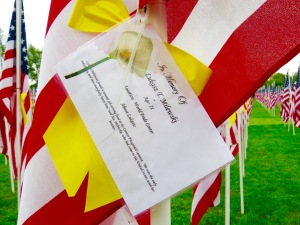 Lukasz immigrated to America from Poland in July– just two months before. His parents came one year earlier, leaving their two children behind to finish school while they prepared a new home for them in the land of opportunity. When he arrived, Lukasz immediately found a summer job working in food service for Cantor Fitzgerald at the World Trade Center. A start of a new life. America.
Only two short months. His American Dream was cut short. Stolen from him.
This is just one story. One heartbreaking story– of many– that would not reach their natural conclusion. His opportunity, his voice, his life– silenced.
The passing of fifteen years has done little to take away the great empathy and sadness I feel for the many lives lost on September 11th, 2001. My heart goes out to the families whose futures were forever changed– whose hopes and dreams were so unexpectedly taken from them.
Life goes on.
I pray that they have found peace.
I pray that they have achieved some level of happiness.
Life goes on.
We remember.
We will always remember.
But life goes on.
These are the stories we must tell. We can’t be silent. We must be the storytellers. Stories of hopes and dreams. We must honor them by passing down their stories of courage. We will never forget.

Spring Has Sprung at 321 Division St.
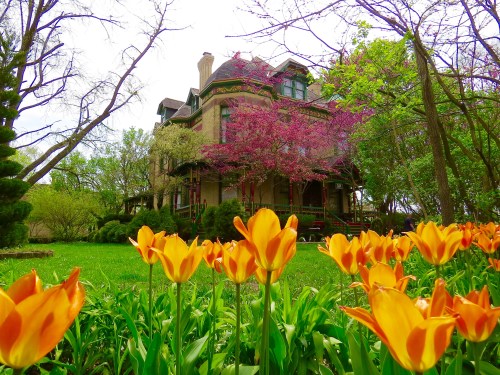
Spring at home. The John Newman House built in 1889 also known locally as ‘The Butterman Mansion’.
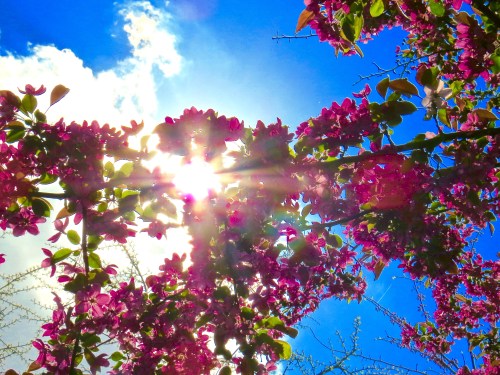
We’ve really been enjoying the many colors of spring. Every year the show is a little bit different so we never quite know what to expect. Blooming started a little earlier than some years and most of the more brilliant colors are gone; replaced now by the beautiful, rich green of new leaves and fresh grass.
Mulching, overseeding and spring clean up are done but there’s always more planting and weeding to do. Working on the yard is one of my favorite things to do in the spring and the fall. It’s great exercise too.
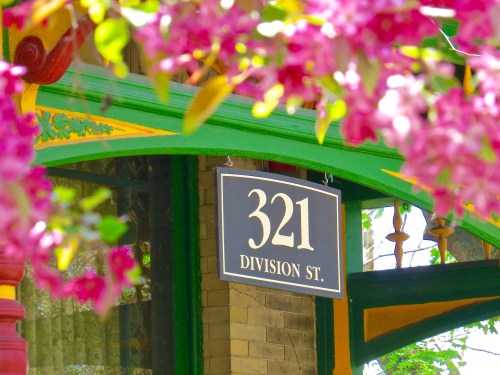
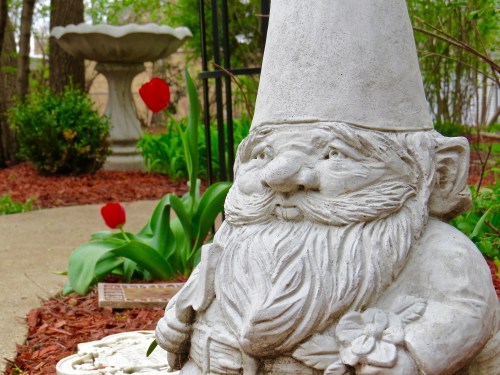
Here are some of the images I was able to catch over the past month.





When I Was A Kid…
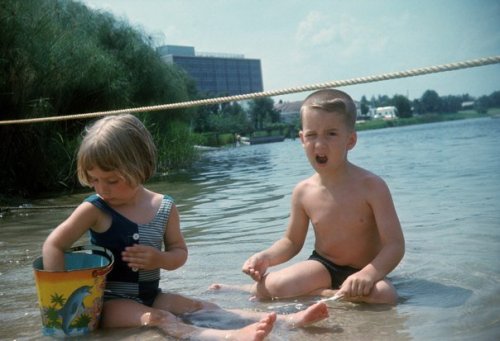
With my sister in 1967.
I spent most of my childhood, growing up in a small town in Florida.
When I was a kid…
- We played outside.
- We played outside without our parents having to watch us.
- We played Cowboys and Indians, Cops and Robbers or War. (and never really thought about actually owning a gun!)
- We dug in the dirt.
- We made forts and hideouts on empty lots with brush and debris.
- We rode bicycles for hours. (Without helmets.)
- We sometimes built a fire and slept in a tent in the backyard.
- We were often barefoot.
- For special entertainment, we played outside at our cousins’ houses.
When I was a kid…
- We had daily chores like dusting and washing dishes.
- We read books. My sister and I checking out 20 books at a time from the library.
- We learned how to grow vegetables in a garden.
- We saved our allowance all year so we could buy Christmas presents for our family.
- If we wanted candy or ice cream, we picked up pop bottles and cashed them in for their deposit at the nearby convenience store.
- We did our homework without being told. (And it actually affected our grades.)
When I was a kid…
- If we had fast food it was a special occasion. A sit down restaurant was an event.
- We watched television less than 3 hours a day.
- When we wanted to look something up, we used the encyclopedia.
- Telephones had cords and were only used for important (short) conversations.
- We wrote letters and mailed cards for birthdays and holidays.
- Dessert was a rare treat not a daily source of nutrition.
- We drank water from the tap (or even from the hose). We had pop/soda no more than once a week.
- Other than going to the grocery, shopping was only something you did for school clothes and at Christmas.
- If there was something you really wanted, it didn’t magically show up at the end of the day. If you were lucky in might show up under the Christmas tree.
- We didn’t hang out at the mall or see all the current movies. (I can count the movies I saw growing up on my fingers.)
- We learned to draw, write, and made and built things with our hands.
- We knew how to use our imaginations.
When I was a kid…
- We didn’t have computers, or Internet, or Smart Phones or cable TV.
- If we wanted to communicate, we opened our mouths.
- Safety was something you did, not a government mandate.
- Teachers weren’t babysitters, they were actually allowed to teach class.
- We didn’t always lock our doors.
- Black Friday didn’t start in July.
When I was a kid…
- We loved our country and believed in the American Dream.
- Politicians were intelligent and respected– they were our heroes.
- Congress did something.
- We weren’t afraid of Police. They were there to help us.
- Guns were only used by soldiers, police and hunters.
- Most families we knew only had one working parent, with one job and they were able to live comfortably.
- We were taught honesty and hard work were the keys to success.
- We thought people were just people regardless of color, class or religion.
- You could believe what you heard on the news.
- Everyone wasn’t out to get you.
Then we grew up…
And everything changed.
Learn, Adapt, Repeat
 There is a phenomenon occurring in this country in the form of two candidates: Donald J. Trump and Bernie Sanders. They are calling for a revolution. Many people are jumping on board the train without any real idea where they’re going or where they’ll end up. The Trump camp wants to “make America great again” by basically dragging us back in the past. The Sanders camp wants to push us forward into the unknown. Both candidates have very different messages. Nonetheless, their platforms or sound bytes are igniting an America that has long sat indifferent and unmoved.
I hope a lot of people will read on and hear what I have to say. I’m not going to intentionally bash either candidate– but I do hope you’ll consider some of what I’m hoping to express.
What are the driving motivations and emotions behind all this hysteria in this election cycle?
People are frustrated and angry. People don’t trust the government or the people running it. People are searching– but for what?
Hope and change.
Recognize the irony here? This was President Obama’s campaign platform. Most everyone weighing in will say that he has failed, at least on some level. The Republicans, besides being against the Affordable Care Act, will say that Obama has led the economy off the deep end– even though the numbers prove that it (the economy) is in much better shape than it was when he took office in 2008. The Democrats will say that his policies and contributions have not gone far enough. The obvious fact, that both sides will agree on, is that he has been unable to unite the parties and inspire them to work together. The underlying fact– Congress is not doing it’s job and merely electing a new President is not likely to change that.
“…. and to the Republic for which it stands….”
At this point, I need to remind everyone that America is a Republic, not a Democracy. What does that mean? In a Democracy, citizens directly vote on laws. In a Republic, as in the United States, we elect representatives to pass laws for us.
With the exception of often highly scrutinized Executive Orders, the President can’t actually make laws or enforce policy. Congress does that…. or at least that is what we elect them to do. If they fail and we continue to re-elect them? Isn’t it our own fault?
Our Constitution wisely established three separate (but equal) branches of government to protect and represent all of us: Executive, Legislative and Judicial.
So why does it appear that the American people ignore all but the Presidential race when it comes to voicing their expectations? Why do Americans hold the President accountable but not the equally powerful representatives they elect?
Going to the Dogs
Okay, now bear with me here….
I just finished a class in Dog Emotion and Cognition. The parallels in understanding human development and interactions are uncanny. Cognition is made up of multiple levels including: memorization, understanding and application. These are affected by experience, environment and genetics among other things. No two dogs, even of the same breed, have the exact same cognitive abilities. So in order to train a dog or change it’s behavior you have to first understand how the dog thinks and processes things. Once you understand, you can adapt your training method to achieve the desired result. If you are only partially successful, you may have to start back at the beginning and try a slightly different approach.
Learn. Adapt. Repeat.
Learning and behavior in people can be looked at in the same way. Every person is different in how they learn, process and experience things. The nationwide failure of our education system is that we’ve developed a strict style of learning that does not nurture or support people in their individual, cognitive strengths. No person is unable to learn. They may just need to be taught differently. When a teacher is given the latitude to explore and find a student’s strengths– only then can they effectively teach.
Learn. Adapt. Repeat.
How does any of this apply to the election?
Political Change
 Learn. Whether you are Conservative, Liberal or Progressive you first need to understand what it is that needs to change. Settling on concerns such as better pay, a more stable economy or national security are not enough. You need to understand why and how the current situation exists and have some idea of how to correct it.
Voting for a candidate that makes campaign promises you agree with isn’t enough. People will say anything to get elected. They may even believe what they say. Do they have an actual plan to make it happen? (Trump openly acknowledges he has repeatedly taken advantage of the system he now says he will change. Sanders has been a member of Congress for 23 years and refers to the system as broken but say he will fix it.)
Adapt. Once you are well informed, then you can take action.
Every piece of legislation considered and/or passed, affects or is affected by every other law that already exists; either directly or indirectly.
Change requires action. Some action may correct one problem while creating another. The goal of government is suppose to be to establish and defend a fair, level playing field; giving every American the chance to be successful in their own right.
Repeat. When new problems arise– they need to be corrected. When loopholes are exposed and exploited– they need to be repaired and filled. Sometimes policies and laws should be repealed or re-written instead of piling on new ones to further complicate the process. This isn’t what normally happens. One inadequate law- spawns four more inadequate laws- which spawns twelve more inadequate laws. What’s worse? Many laws are passed and then aren’t enforced. Complicating our legal system only ends up hurting those it is supposed to protect.
Sometimes the political process works and sometimes it doesn’t. It doesn’t get fixed when no one is trying.
Evolution is the Revolution
Everything evolves. Nothing stays the same whether we actively seek change or sit by uninvolved and dispassionate.
In order for change to happen– it must happen on every level.
In order for change to happen– It must start at the ground level.
Change starts with you.
If you really want a revolution, you have to be an active part of that revolution. Be informed. Make your voice heard. Your elected officials need to be held accountable.
No candidate will enact change on their own and simply voting is not enough. You have to be an active part of the process. You have to be aggressive and can’t become apathetic. Otherwise, you’re just passing the buck.
Two Wonderful Little Films You’ve Probably Never Seen
So far this year, I’ve already watched 57 films — both at home and in theaters; commercial and independent releases. I’m not a movie blogger but occasionally I run across a film that I feel like I have to share. Here are two that you’ve probably missed.
Six Dance Lessons in Six Weeks (2014)
Director: Arthur Allan Seidelman
Screenplay: Richard Alfieri
Actors: Gena Rowlands and Cheyenne Jackson with cameos by Julian Sands and Rita Moreno
Running Time: 1 hour, 47 minutes
Teaser: A retired woman hires a dance instructor to give her private dance lessons at her home — one per week for six weeks. What begins as an antagonistic relationship turns into a close friendship as they dance together. (More)

Based on the short-lived, two person Broadway play, Six Dance Lessons in Six Weeks is a charming little film full of schmaltz. It received only a very limited theatrical release.
I found it to be laugh-out-loud funny and heart-warming.
The on-screen chemistry between Rowlands and Jackson is some of the best I’ve seen in years. I was completely engaged from beginning to end.
In spite of the title, this is not a dance film. It is a film about unlikely connections and how they can enrich our lives.
My rating: 9 Stars (out of 10)
Eden’s Curve (2003)
Director: Anna Misawa
Screenplay: Jerry Meadors, Hart Monroe
Actors: Trevor Lissauer, Julio Perillán
Running Time: 1 hour, 31 minutes
Teaser: A coming of age romantic drama set in 1972 based on real life events. This is Peter’s story; an 18 year old boy who takes a journey through a conservative southern all-male university in order to discover himself. With the help of his roommate, Joe and his roommate’s girlfriend, Bess, Peter begins to explore more about himself and his values only to be crushed by those who love him. The path becomes blurred and treacherous and Peter learns that only by relying on the strength of strangers will he be able to heal himself. The decisions he makes when confronted with this new truth will affect him forever. (More)

The Merchant Ivory film, Maurice (1987) came to mind while watching Eden’s Curve. I believe that’s because of the haunting mood and dreamy-like quality of the storytelling.
This film didn’t pull me in immediately but once it did– I was hooked. Younger audiences may have a hard time relating to the difficulties of coming of age and coming out exemplified in this film. (Times have changed.) For me, there was a direct connection.
Sexual situations play a prominent role in this film, which might not be for everybody.
This small budget Indie film is beautifully done.
My Rating: 9 Stars (out of 10)
I know I haven’t gone into great detail here but hope to entice you enough to discover these films for yourself as I did.
Six Dance Lessons in Six Weeks and Eden’s Curve are available on DVD and currently available to stream for free with an Amazon Prime membership.
Latest Posts
-

The Magic of Macon, France
(NOTE: I will be adding more contentto this post in the very new future! I am reworking some of my blog– I apologize for the…
-
Day and Night in Lyon, France
5/26/17- Lyon is the third largest city in France but it doesn’t feel like a big city. It has a historic and classical feel while…
-

A Taste of Twin Cities: Tournon-sur-Rhône and Tain-l’Hermitage
5/25/17- Today we had the opportunity to explore the twin cities of Tournon-sur-Rhône and Tain-l’Hermitage in the heart of the Côtes du Rhône, wine-producing region…
-

Travel 2017: A Special Concert in Viviers: Day Twelve
We woke up this morning to another beautiful sunrise. This time, docked at Viviers in southern Ardèche, we had the beautiful Viviers Suspension Bridge in…
 How Do You Measure 525600 Minutes?